In Brief
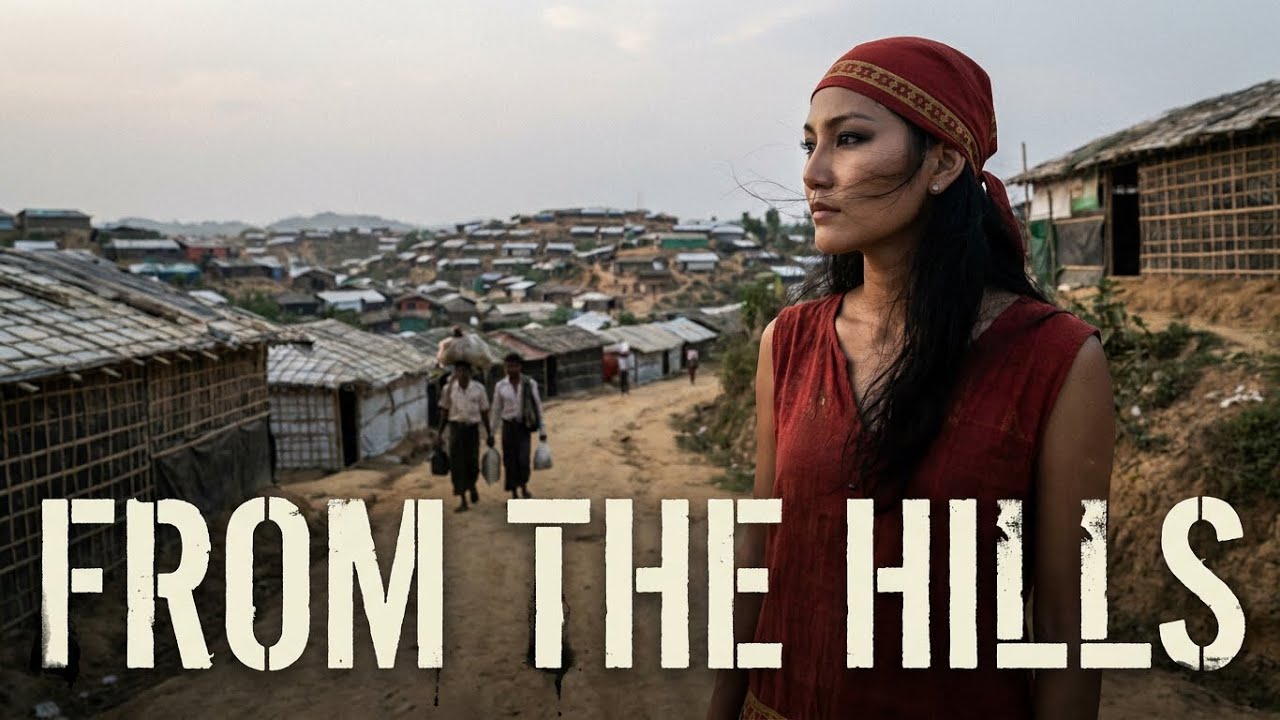
From the Hills is a 3-minute, 43-second AI music film by Winston Chow, featuring Kara Marauder. It was built from fieldwork on the Thai–Myanmar border.
- The film: It began as a reporting trip to document the fallout of aid cuts. It became a music film that blends real border footage with generated reconstruction.
- The thesis: AI filmmaking's most important use may be access rather than spectacle, showing realities that matter but cannot be filmed. That holds only when the reconstruction is disclosed, tied to reporting, and directed by someone with something to say.
- The issue: Refugees, migrants and trafficked workers are caught in the border's third economy of scam compounds, casinos, drug labs and trafficking.
- The method: What was documented and witnessed where cameras couldn't go became music and film that can move an audience, without being passed off as evidence.
The Shot
Kings Romans is a crown-branded casino on the Lao bank of the Mekong. Visitors crossing from Thailand hand over their passports to get in. Winston Chow lives in Bangkok, and he knew what a photograph taken inside could cost him. "Taking pictures in there is very dangerous," he says.
Across the border in Myanmar, the scam compounds are run by what Chow calls "criminals with a monopoly on violence." The drug labs were off-limits. Inside Mae La, the refugee camp where children have been born and raised in shelter meant to be temporary, a camera could put people in danger.
Chow went to the Thai–Myanmar border to document what happens to displaced people when international aid disappears. He came back with interviews, reporting and hours of footage. "We came home with all the information around the shot," he says, "but not the shot."
What he made instead is From the Hills, a music film that weaves that footage together with AI-generated reconstructions of places no camera could responsibly enter. The film is headed for AI film festivals, and it carries an argument: generative filmmaking's most important use may be access, not spectacle.
"The technology came after the subject," Chow says. "The reporting created a visual problem. Generative filmmaking was a way to show what couldn't be photographed safely, ethically or practically."
The Trip
The project began as fieldwork, not as an AI experiment.
The trip set out to document the human consequences of USAID's closure and of deep cuts to international development and humanitarian aid.
Those cuts were already disrupting the healthcare and food assistance that refugee communities had relied on for years. Chow wanted to trace the distance between a budget decision in a distant capital and where it finally lands: a clinic that can't provide services, less food, a family facing more uncertainty.
"We didn't arrive with a story already written," he says. "We went to listen." The goal was to understand how humanitarian, political, migration, security and criminal issues fit together.
Chow traveled with two colleagues. Minchul Kim, a Korean filmmaker, directed in the field. Don Pathan is a veteran journalist and former AP correspondent with long experience covering conflict, politics and security in the region. His long-standing relationships with Thai military and police would prove essential in sensitive border areas.
Before leaving, the team was briefed by Mark McDowell, who had worked with Chow at The Asia Foundation.
McDowell was Canada's first resident ambassador to Myanmar. He opened the embassy in Yangon in 2013, after roughly 25 years of almost no contact between the two countries. From 2003 to 2007 he led the political section at Canada's embassy in Bangkok and made more than 20 trips into Burma.
He was known as an unconventional diplomat. In 2008 he criticized Canada's hard-line sanctions, which included funding opposition groups on the Thai side of the border, arguing they left Canada with no influence.
He later led International IDEA's Myanmar program on elections and constitutional reform. From 2020 to early 2025 he was The Asia Foundation's country representative for Myanmar, through the 2021 coup and its aftermath.
"Mark was very, very supportive," Chow says. "He told us who to contact, introduced us to activists in the region, and was very forthcoming about what to expect. He briefed us on the facts and issues around the refugee camps. It was an amazing briefing."
The Border
The team worked in Mae Sot, at Mae La refugee camp, and along the Thai–Myanmar border. They visited Mae Tao Clinic, which has served people from across the border for decades, and interviewed Burmese activists, journalists and filmmakers.
Mae La broke the idea that a refugee's life is a temporary interruption. People have lived in the border camps for years, some for decades. Children have been born and raised there.
"Those children don't experience themselves as symbols of a refugee crisis," Chow says. "They're kids, with personalities, friends, relationships and plans. Their circumstances are extraordinary, but their lives are still ordinary lives."
The team interviewed young filmmakers from Border Echo, Burmese storytellers documenting what is happening to their own country and communities, with far more at stake than any visitor.
The most important interview was with human-rights activist Thinzar Shunlei Yi. She grew up in a Myanmar military family and spent much of her early life inside the military environment before becoming one of the country's most prominent activists.
She spoke about activists, safe houses, military and police defectors, and what defection costs. The story, she made clear, is not only the soldier's. When someone leaves the military, wives, children and other relatives can see their security overturned overnight. They need somewhere safe to stay. Families move or hide.
"She comes from a military family," Chow says, "and she has the bravery to help defectors and their children and spouses."
What stayed with him most was her account of the danger following them. According to Thinzar, the Burmese military sends gunmen, essentially assassins, into Thailand to go after defectors and their families living near the border.
"I found that particularly disturbing, considering the border," Chow says. "You think of crossing it as reaching safety. For these families, it's a line the danger can cross too."
Her experience breaks the neat categories of soldier, activist, defector, victim and family member. So does much of what the team saw.
The tension followed the team too. The scam-compound crisis had sharply increased security along the border. There were soldiers and many checkpoints, and at times real stress.
Chow believes the team could have been detained or questioned at length without Pathan's relationships and credibility. He is careful not to overstate it. "Whatever risk we carried for a few days, the people who live there carry far more of it every day."
Nor was the security hostility toward the project. In Bangkok, the team met representatives of the Royal Thai Armed Forces and informally received meaningful encouragement. They found real recognition that the humanitarian, trafficking and security issues deserved attention.
"I want to express my appreciation to the Royal Thai military for that engagement," Chow says. Border personnel, he notes, face real responsibilities: trafficking, organized crime, narcotics, irregular crossings, and the spillover of Myanmar's war.
The Third Economy
The trip coincided with intense international attention on the scam centers operating across the border in Myanmar. What looks at first like a cybercrime problem is, Chow says, a human-rights and human-trafficking crisis.
Foreign nationals are deceptively recruited, and some are abducted or otherwise trafficked through Thailand and across the border into the compounds. They come from the Philippines, Nepal, African countries and elsewhere. They are sought out because they speak English and other languages valuable for scamming targets.
Inside, documents are confiscated. Workers are forced into online fraud under confinement, threats and violence.
"The person trying to scam you online may be a perpetrator of fraud and a victim of trafficking at the same time," Chow says. "The film had to resist easy moral categories."
The reporting showed how separate problems overlap. Civil war produces displacement. Displacement and statelessness create vulnerability. Economic desperation exposes people to exploitation. Borders create legitimate economic opportunity, and openings for criminal networks.
Refugees, migrants, stateless people, activists, defectors, scam compounds, casinos, methamphetamine and yaba, human trafficking and wildlife trafficking all belong to overlapping systems. "I'm not saying one organization controls all of it," Chow says. "It isn't a conspiracy. It's an ecosystem."
Where Cameras Can't Go
The team came home with interviews, reporting, firsthand observation and real footage. They had border camps and markets, Thai soldiers guarding the frontier, the exterior of Mae La, drone shots and barbed wire. But some of the most important realities could not responsibly be filmed.
Chow lists them. At Kings Romans, entry from the Thai side meant handing over his passport. "I also live in Thailand," he says, "so taking pictures inside is very dangerous."
The call centers are the scam compounds. "They're essentially owned by criminals that have a monopoly on violence in that region, and the gunman story made that even scarier." The drug labs were impossible.
Life inside Mae La was also closed, because of what the refugees face. "A lot of them are activists," Chow says. "A lot of them make their own films, and that's up to them. But this isn't something we could gain approval for from the Thai government."
Even where access might have been possible, the ethics were not. Identifying vulnerable people could put them in danger. Asking survivors to recreate trauma just to get footage would be its own harm.
That left two kinds of closed door. The compounds, casino and labs keep cameras out to hide crimes. The camp keeps them out to protect people. From the Hills reconstructs both, for opposite reasons, and says so.
"The technology came after the subject," Chow says. "I didn't decide to make an AI film and then look for a socially important topic. The reporting created a visual problem, and generative filmmaking offered a way to represent what couldn't safely, ethically or practically be photographed."
He does not call the result a documentary. It is a music film informed by documentary fieldwork, interviews, reporting, actual places and real conditions. The generated images are cinematic representations, not documentary evidence.
"The ethical line is between reconstruction or interpretation," he says, "and fabrication falsely presented as evidence."
The film holds that line with four rules:
- Real footage is used with faces altered to protect people.
- Every generated scene must be tethered to reporting or testimony. "If there's no voice behind a shot, it doesn't ship."
- Kara Marauder's performance marks the film as art, not evidence.
- One unified film finish pulls the real footage toward cinema, rather than dressing generated footage up as documentary.
The film itself changed as Chow made it. "I knew I wanted to use a good portion of the footage we got there, and weave through how it could be used and made to look good," he says. "That made it more complex."
"At first I was inspired to make a music film because I thought it was cool and interesting, and there were a lot of concepts I could weave into the lyrics. As I started to make it, I realized there's something meaningful here, right on the cusp between documented video and generated video."
What Belongs
The fieldwork became a constraint on every generated image.
Chow set out to avoid the generic Western clichés of Southeast Asian poverty: sad children, dusty roads, guns, corrugated metal, theatrical misery. He also rejected anything too fictional, like a compound as a sci-fi prison, a cartel-movie drug lab, or a crying child in golden light.
"I wanted to make everything feel real, the way I've seen it and the way it's been reported," he says.
Ordinary life had to stay visible. People cook, repair things, talk, play, work, get bored, listen to music, form relationships and make plans. "Vulnerable people shouldn't be reduced to the worst thing that has happened to them."
The film is drawn to the people at the edges of headlines. A soldier defects, but his wife and children live with the consequences. An activist protests, but others may have to hide or protect them. Aid is cut, but the consequence arrives inside individual households. Children, above all, are not to be used as emotional devices.
The compounds, in Chow's telling, are frightening because they are ordinary. They are offices and casinos, computers and dormitories, roads, fluorescent lights and people working at desks. Exploitation can begin by looking like a real job.
The workforce is striking for how international it is, drawn from many countries for their languages. "The starkness, the banality," Chow says. "These things don't exist in the minds of people who have never been in the region."
He also worried that cinematic beauty could aestheticize suffering. He rejected striking material when it felt false, geographically or culturally wrong, or too theatrical, and whenever suffering started to look like production design.
"The question was not 'Is this a great shot?'" he says. "It was 'Does this shot belong in this film?'"
The Witness
Kara Marauder is based on a real human performer whose likeness is used with consent. The performer's own identity stays private.
In From the Hills, Kara cannot become a glamorous outsider who makes other people's suffering her story. She works as a witness: a conduit, a presence the audience moves through from one environment to the next. She rescues no one and does not explain Myanmar to the audience.
"At times she needs to recede," Chow says, "because the film does not belong to Kara."
She also never reaches the city. For people leaving rural poverty, the city stands for growth, mobility, laws, safety, numbers and transparency, a place where things can be seen.
Kara's failure to arrive is a poetic reading of disillusion, not a verdict. Many people do build a living by moving to the city. But the film is about where displaced people so often end up instead.
The music carries what exposition can't. "Music lets the audience experience the relationships between images before they're explained," Chow says.
It can connect displacement, borders, casinos, workers, children and trafficking without turning a short film into an illustrated policy report. It also gives the film movement and life, so it doesn't become a procession of suffering.
The Director
Traditional production is built on scarcity: filmmakers edit what they actually captured. Generative production creates abundance. Another shot, camera move, expression, environment or version is always available.
That, Chow argues, makes selection, taste and commitment more important than ever. "The machine can create visual material," he says. "But it didn't visit Mae La, interview Thinzar, travel with Don, or hear Border Echo. It didn't understand why any of it mattered. Deciding what belongs remains the director's responsibility."
On authorship, he is direct. He set the subject and structure, selected and rejected the material, and determined composition, performance, camera logic, pacing, music, sound and edit.
"Generative systems participate in image creation," he says. "But filmmaking has never required a director to personally manufacture every physical component in a frame. The real question is whether a human filmmaker has something to say, and exercises meaningful authorship over how it's said."
His two decades in international development shaped that sense of purpose. He worked in places where human circumstances became programs, budgets, indicators and policy frameworks. Fieldwork reversed the abstraction.
"A budget cut becomes a clinic unable to operate," he says. "Conflict statistics become families unable to return home. Migration policy becomes one person standing at a border."
Film, for him, is a different vocabulary for making those consequences emotionally legible. It does not replace journalism or policy analysis.
The Test
Chow applied one question to every frame.
"If the people we met along the border could watch this film," he says, "would I feel comfortable sitting beside them while they watched it? If the answer is no, the image does not belong."
In a medium that can generate anything, it is the one question the machine cannot answer.
From the Hills was made by Reactor Corp Studios using Seedance 2.0, Nano Banana Pro, GPT Image 2 and Suno, together with real photographs and video collected in early 2026.
Reactor Corp Studios is an experimental generative AI film studio based in Bangkok, founded by Winston Chow. It makes cinematic shorts, documentary-informed films and music films, including the Kara Marauder music videos, and is building a role as a co-producer and financier in AI filmmaking. Its work has been selected at festivals in Italy, the United States and Indonesia, and won the Bronze Prize for AI Music Video at the K-Culture AI International Film Festival in Seoul in 2026.